
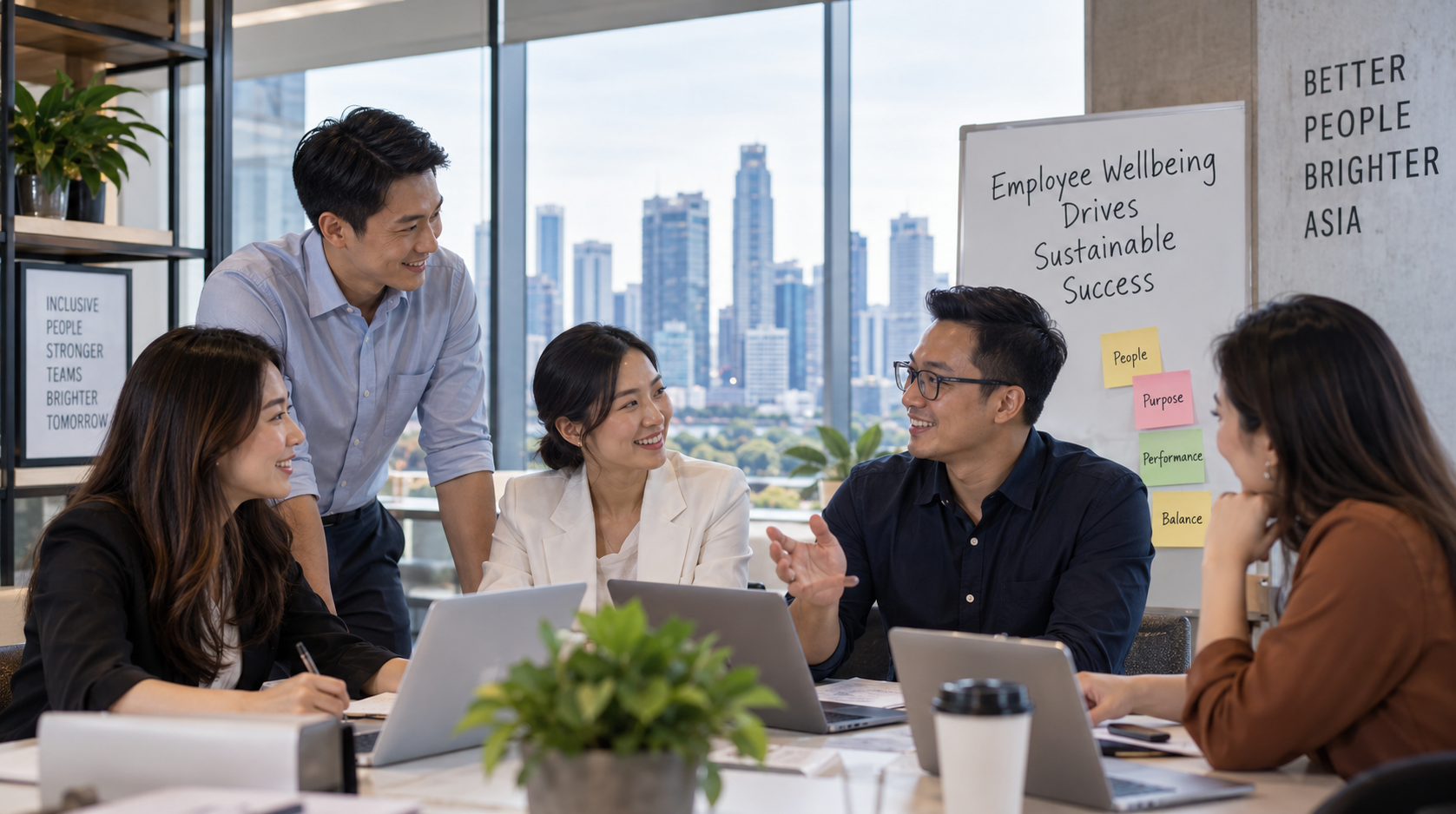
Across Asia, ambition is everywhere. From Singapore’s financial and technology sectors to rapidly expanding businesses in India, Malaysia, Vietnam, the Philippines and other emerging markets, organizations are competing for growth, talent and innovation. This momentum creates opportunity. But it also creates pressure. Long working hours, demanding targets, constant digital communication and increasingly blurred boundaries between professional and personal time can gradually become accepted as normal.
For HR leaders, this raises an important question:
Can organizations maintain high performance without creating a culture where exhaustion becomes a measure of commitment?
The answer requires us to rethink what sustainable performance actually means. Hard work is deeply respected across many Asian workplaces. There is nothing inherently wrong with that. Commitment, discipline and resilience have helped organizations and economies across the region achieve remarkable growth. The problem begins when visible busyness becomes more valuable than meaningful outcomes. Employees may feel pressure to remain in the office because their manager is still working. Others may hesitate to take leave during busy periods or feel they must respond to messages late at night. Over time, these behaviors can become unwritten cultural expectations. No policy document needs to say, "You must always be available." Employees learn the expectation by observing what gets recognized and rewarded. That makes wellbeing a cultural issue not simply an HR program.
Wellbeing Is More Than Wellness Activities
Many organizations have introduced wellness program, counselling services, health initiatives and employee engagement activities. These can be valuable. But organizations should be careful not to confuse wellness activities with workplace wellbeing. A yoga session cannot compensate for consistently unrealistic workloads. A wellbeing webinar cannot fix poor management. An employee assistance program cannot replace a culture where people feel safe discussing workload or asking for support. Real workplace wellbeing begins with how work itself is designed. HR leaders should therefore look at workloads, management practices, communication expectations, staffing levels and role clarity alongside traditional wellness initiatives.
Managers Are Often the First Line of Prevention
Managers occupy a particularly important position. They are often the first people able to notice when an employee's behavior changes. Someone who was previously engaged may become unusually quiet. Performance may decline. Absence may increase. A normally collaborative employee may begin withdrawing from colleagues. Managers should not be expected to diagnose personal or medical issues. They should, however, know how to have a respectful conversation. Sometimes a simple question "How are things going with your workload?" can create an opportunity for an employee to speak openly before a manageable problem becomes a serious one. This requires organizations to develop managers not only around performance management, but also around empathy, communication and responsible leadership.
Another important part of sustainable performance is psychological safety. Employees need to feel able to raise concerns, acknowledge mistakes, ask questions and respectfully disagree without fearing unnecessary embarrassment or punishment. This can be particularly important in workplaces where hierarchy is strongly established. Respect for seniority can coexist with open communication. The objective is not to remove hierarchy altogether. It is to prevent hierarchy from becoming a barrier to information. When employees are afraid to tell leaders that a deadline is unrealistic, a customer is unhappy or a project is heading in the wrong direction, the organization loses valuable information. Creating a culture where employees can speak early can improve both wellbeing and business performance.
Technology has made Asian workplaces faster and more connected. It has also made employees easier to reach. Email, messaging platforms and mobile devices mean that work can follow people almost anywhere. This creates a cultural challenge. Just because an employee can respond at 10:30 p.m. does not necessarily mean the organization should expect them to. Leaders play an important role here. If senior managers regularly send non-urgent messages late at night and expect immediate responses, employees quickly understand the unwritten expectation. Organizations can instead encourage clearer communication norms around urgency, response times and after-hours contact. Small changes can have a significant cultural effect.
Flexibility Should Work Both Ways
Flexible working has become an important discussion across Asian markets. However, flexibility should not simply mean employees being available whenever the organization needs them. Sustainable flexibility needs reciprocity. Employees may occasionally need to adapt to business demands. Organizations should also recognize that employees have responsibilities and lives outside work. Different industries will naturally require different approaches. A manufacturing plant, hotel, hospital and technology company cannot operate under identical flexible working models. The principle, however, remains relevant:
Design work around outcomes and operational needs while giving employees reasonable autonomy wherever possible.
Organizations should not interpret employee wellbeing as lowering standards. Sustainable performance still requires accountability. Employees need objectives. Teams need deadlines. Businesses need results. The difference is that sustainable organizations consider whether their people can continue delivering those results over time. A team that achieves exceptional results for three months before losing several experienced employees may not actually be performing sustainably. HR leaders can therefore examine performance alongside indicators such as turnover, absenteeism, engagement, overtime patterns and internal mobility. These signals can reveal whether performance is being created through healthy systems or through excessive pressure.
The Asian Workplace Is Changing
Younger professionals entering workplaces across Asia are also changing the conversation. Many still value career progression and financial security, but increasingly they are asking questions about leadership quality, flexibility, purpose, development and workplace environment. Employers do not need to respond to every preference. Organizations competing for skilled talent may increasingly find that their workplace culture becomes part of their employer proposition. Candidates are not only asking: "What will I earn?" They are also asking: "What will it be like to work here?" That is a cultural question.
Building Healthier High-Performance Cultures
There is no universal formula for employee wellbeing across Asia. Each country, industry and organization has different realities. But several principles remain consistent. Set clear expectations. Develop capable managers. Monitor workloads. Encourage employees to speak up. Create reasonable communication boundaries. Recognize contribution rather than simply visibility. Give employees opportunities to recover after demanding periods. Most importantly, leaders must demonstrate the behaviors they expect from others. A company cannot promote work-life balance while senior leaders consistently celebrate excessive working hours. Culture follows behavior more closely than policy. Asia does not need to choose between ambitious businesses and healthier workplaces. The opportunity for HR leaders is to build organizations where high performance can be maintained because people have the environment, leadership and support required to sustain it. That may ultimately be a more meaningful definition of a high performance culture.